Quick wins before you panic
Travellers are changing the way they search.
They are asking longer, more specific questions. They are using tools like ChatGPT, Google Gemini and Claude to plan where to stay. And they are expecting clear, useful answers before they ever land on your website.
So, is your boutique hotel visible to AI?
There has been a lot of noise around AI search lately. Some of it is useful. Some of it feels like scaremongering.
Our take is simple:
Don’t panic. Get the foundations right.
AI visibility is not magic. It is usually the result of being easy to find, easy to understand and easy to recommend.
For boutique hotels, that starts with the same digital foundations that have always mattered: your Google Business Profile, your website, your FAQs, your OTA listings and your direct booking message.
The difference now is that weak foundations are becoming more visible.
If your hotel website is out of date, your OTA listings tell a different story, or your Google profile has old information, AI tools have less reliable information to work with. That makes it harder for your hotel to be recommended when travellers are researching where to stay.
That’s why we created our new, free guide:
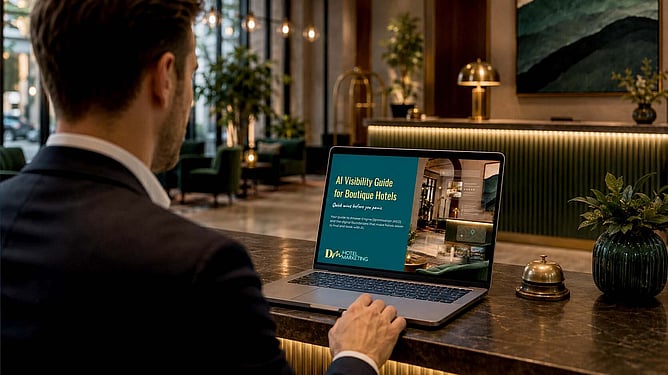
AI Visibility Guide for Boutique Hotels
The guide covers five practical areas every hotel should review.
These are not flashy AI hacks. They are the key things that help search engines, AI tools and real travellers understand why someone should choose your hotel.
1. Update your Google Business Profile
For many travellers, Google is still the first impression of your hotel.
Your Google Business Profile should be accurate, complete and actively managed. That means checking your hotel name, address, phone number, website link, category, photos, reviews and hotel details.
It sounds basic, but it matters.
AI search tools are trying to provide useful answers quickly. If your Google profile is incomplete, outdated or inconsistent, you are making it harder for your hotel to be understood and recommended.
Quick win: Review your Google Business Profile this week and update anything old, vague or inaccurate.
2. Improve your website content
AI search does not remove the need for a good hotel website. It makes a good website more important.
Your website should clearly explain:
Who your hotel is for
Where it is located
What makes the stay different
What room types you offer
What experiences are nearby
Why someone should book direct
A lot of hotel websites are thin on copy, awkward on mobile or written in generic language that does not help a traveller make a decision.
If your homepage could apply to almost any hotel in your region, it probably needs work.
Search engines and AI tools need clear, specific content. So do real guests.
Quick win: Start with your homepage. Then review your room pages, location page, offers, dining, experiences and book direct messaging.
3. Add useful FAQs
FAQs are one of the simplest ways to improve both SEO and AI visibility because they mirror how travellers actually search.
People ask practical questions before they book:
Is parking included?
Are you family-friendly?
Do you allow pets?
How far are you from the airport or town centre?
Is breakfast included?
Do you have EV charging?
What is the cancellation policy?
Which room is best for accessibility?
These questions might not feel exciting, but they are exactly the type of content AI tools can summarise and search engines can understand.
The key is to write FAQs that are genuinely useful. Not filler. Not keyword stuffing. Just clear answers to the questions guests actually ask.
Quick win: Add 10 to 20 helpful FAQs to your website, written in plain English.
4. Keep OTA and metasearch listings consistent
AI tools and search engines do not only look at your website.
They also look at Booking.com, Expedia, Google Hotels, Tripadvisor and other travel platforms.
If each channel tells a slightly different story, you create confusion. One platform might use old room names. Another might have outdated amenities. Your website might describe your property one way, while your OTA listing describes it another way.
That lack of consistency can affect trust.
Your website, OTAs and metasearch listings should all tell the same story, with the same core details and the same trust signals.
Quick win: Audit your top OTA listings and align the property descriptions, room names, amenities, policies and key messages with your official website.
5. Make your direct booking message clear
Being found is only useful if it leads to bookings.
Your direct booking benefits should be obvious before guests reach the booking engine.
Too many hotels hide their direct booking message in the footer or rely on a vague “best rate guaranteed” badge. If you want people to book direct, you need to give them clear reasons.
Examples might include:
Best rate guaranteed
Flexible cancellation
Early check-in or late checkout
Exclusive packages or inclusions
Instant loyalty rates
Direct access to the hotel team
These benefits should appear on your homepage, room pages and booking journey.
Quick win: Write down five reasons someone should book direct, then add them to your homepage and booking engine.
What is AEO for hotels?
AEO stands for Answer Engine Optimisation.
SEO helps your website show up in search engines.
AEO helps your hotel become a useful answer when travellers ask conversational questions in tools like Google AI, ChatGPT, Gemini or Claude.
For hotels, this means creating content around the questions travellers actually ask, such as:
Best places to stay near [destination]
Where to stay for a romantic weekend in [region]
Best accommodation near [attraction]
Family-friendly hotels in [destination]
Luxury lodge near [location]
Where to stay before hiking [track]
The goal is not to game AI.
The goal is to make your hotel easier to understand, easier to recommend and easier to book.
If your hotel website feels outdated, now is the time to fix it
If your hotel website is more than two years old, thin on content, awkward on mobile or was never built properly for SEO, AI search makes the weakness more visible.
A modern hotel website should be built for:
Clear positioning and messaging
SEO and AEO structure
Mobile-first browsing
Fast load speed
Strong room and experience pages
Direct booking conversion
FAQs and structured content
Tracking and measurement
This is not about chasing an AI trend.
It is about building a stronger direct-booking asset that search engines, AI tools and real travellers can understand.
Need help sorting the foundations?
We are offering an AI Visibility Foundations Package for boutique hotels that want us to audit and fix the key areas.
This includes:
Google Business Profile checks
OTA listing copy and property descriptions
Why Book Direct benefit copy
Top 20 FAQs and answers
Must-do website updates
We review the foundations, identify the gaps, and help you fix the priority areas so your hotel is easier to find, understand and recommend.
Ready to get your AI foundations sorted?
Download the free AI Visibility Guide for Boutique Hotels here:
Or book a call with Damien to talk through what this could look like for your hotel.
Frequently Asked Questions
What is AI visibility for hotels?
AI visibility is how easily your hotel can be found, understood and recommended by AI-powered tools such as Google AI, ChatGPT, Gemini and Claude. It depends on the quality, accuracy and consistency of your digital presence.
How can hotels improve AI visibility?
Hotels can improve AI visibility by updating their Google Business Profile, improving website content, adding useful FAQs, keeping OTA and metasearch listings consistent, and making direct booking benefits clear.
Is SEO still important for hotels?
Yes. SEO is still important. AI search does not replace the need for a strong website. It makes clear, useful, well-structured content even more important.
What is AEO for hotels?
AEO stands for Answer Engine Optimisation. It is the process of creating content that helps your hotel appear as a useful answer when travellers ask conversational search questions.
Do boutique hotels need to rebuild their website for AI?
Not always. Some hotels can start with content updates and listing fixes. But if your website is outdated, thin on content, slow, hard to use on mobile or not built for SEO, a refresh or rebuild may be the best next step.